

Sitting in front of your computer wondering how to break into the IT world? You type “learn programming” into a search engine and are suddenly flooded with a wave of technical jargon: backend, frontend, frameworks, compilers. It’s a moment where it’s easy to feel overwhelmed and give up before you’ve even properly started. But relax! If you want to become a programmer, you need to know that programming isn’t secret knowledge available only to mathematical geniuses. It is primarily the skill of logical thinking, problem-solving, and… patience. If you want to start programming but don’t know which language to choose first, how long it will take, or if you’re even cut out for it – this guide is for you. We will walk you through the process of learning programming from scratch, debunk myths, and show you how to take the first steps towards a career change and a job in the IT industry.
1. Programming for Beginners – Is It Hard?
Many myths have grown around the IT industry that effectively scare off beginners. The most popular one is: “I have to be a math whiz to program.” The truth is quite different. In the daily work of a programmer, complex calculations happen rarely (unless you are creating game graphics engines or advanced banking systems). Much more important is the ability to think analytically and break down large problems into smaller, easier-to-solve parts. Learning programming from scratch is a process that requires consistency, not mathematical talent.
To learn programming, you just need to start thinking in an organized way. Imagine writing a cooking recipe for a robot that knows nothing about cooking. You can’t tell it “make scrambled eggs.” You have to define every step: “take an egg,” “crack it on the edge of the pan,” “pour the contents out.” If you skip a step, the robot will make a mess. That is exactly what writing code looks like. The computer will do exactly what you tell it – nothing less, nothing more. Your task is to learn the language in which you will issue these commands to code effectively. For many people, a beginner’s guide is the key to breaking the ice and starting the adventure with application development.
2. What is Code, Programming Language, and Data Structures?
Before we move on to choosing a specific technology and language, you must understand the “basics of basics,” which are universal regardless of whether you choose Java, Python, or C++. Every programming language is based on a few fundamental concepts worth learning right at the start. If you understand them, learning subsequent technologies will be much simpler, and you will be able to effectively develop your skills.
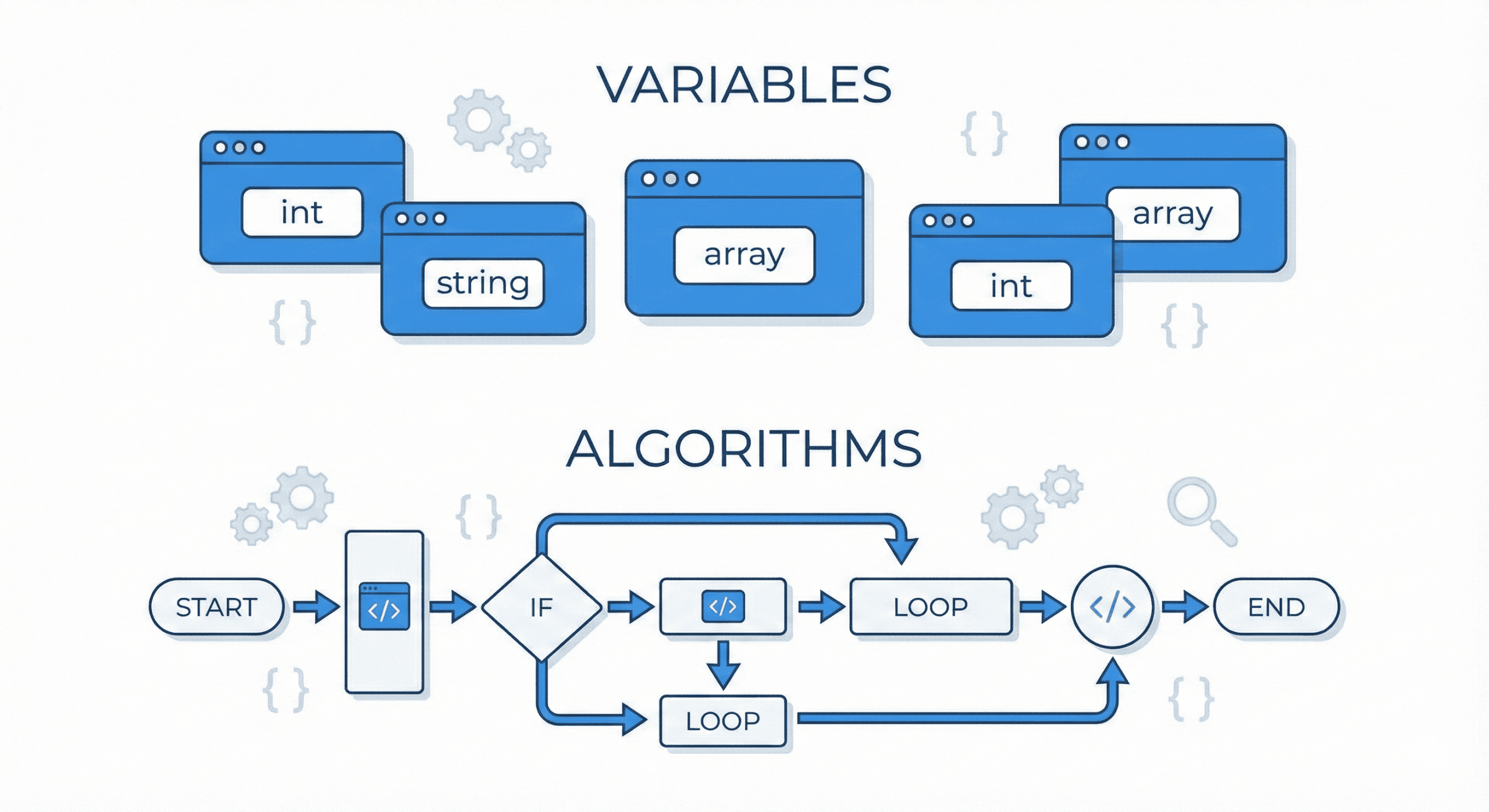
Visualization of data structures: how algorithms organize information.
- Variables: These are simply boxes for data. You can store numbers, text (called a string), or logical values (true/false) in them. This is the basic building block of any program that allows you to encode information.
- Conditional Statements (IF/ELSE): These are decision moments. “If the user clicked the button, display a message. Otherwise – do nothing.” Without this, no code would be interactive.
- Loops: They serve to automate repetitive tasks. Instead of writing the code “display name” 100 times, you write one loop that performs this task 100 times for you. This is the essence of programming.
- Data Structures: These are ways of organizing information. Imagine a shopping list – in programming, this is an “array” or “list.” A phone book (name -> number) is a “dictionary” or “map.” Understanding when to use a given data structure is key to being a good programmer.
3. Which Programming Language to Choose for a Start?
This is the most common dilemma for people who want to start programming. There is no single “best” language, but there are some that are friendlier to start with and offer better prospects on the job market for juniors. Currently, the two giants when it comes to programming from scratch are Python and Java. They differ in philosophy, application, and learning curve. Choosing the right programming language is crucial so you don’t get discouraged at the start.
Why Choose Python?
Python is often described as ideal for beginners. Its syntax is minimalist and resembles the English language. You don’t have to worry about semicolons at the end of the line or complicated curly braces, which can be frustrating at the beginning of learning. In Python, the command `print(“Hello”)` just works. It’s a great choice for both beginners and advanced programmers.
- Application: Data analysis, artificial intelligence (AI), machine learning, task automation, backend, as well as simple web applications.
- Advantages: You see results quickly. You write little code, and the program does a lot. This is very motivating when you are just starting to learn programming from scratch.
- Python Course: The availability of materials is huge, which facilitates self-study.
Example code in Python – simple and readable:
# Python does not require curly braces or semicolons
name = "Anna"
age = 25

if age >= 18:
    print(f"Hello {name}, you are an adult!")
else:
    print(f"Hello {name}, you are still too young.")
When is it Worth Choosing Java?
Java is an Enterprise-class technology dominating in large corporations. It is more rigorous and “verbose” than Python (you have to write more code to achieve the same effect), but thanks to this, it teaches iron discipline and good programming habits. It is a strongly typed language, which means you must precisely define data types – this helps avoid errors in large projects.
- Application: Huge banking systems, corporate systems, mobile applications for the Android system, big data processing.
- Advantages: Huge job market stability. Knowing Java makes it easier to understand other object-oriented languages.
Example code in Java – requires defining a class and types:
// Java is more formal and requires more structure
public class Main {
    public static void main(String[] args) {
        String name = "Anna";
        int age = 25;

        if (age >= 18) {
            System.out.println("Hello " + name + ", you are an adult!");
        } else {
            System.out.println("Hello " + name + ", you are still too young.");
        }
    }
}
It’s also worth mentioning JavaScript. If you are interested in creating websites (the so-called frontend – visual layer) and want your website to be interactive, JavaScript will be essential. It is a language running in the browser, which combined with HTML and CSS allows you to create dynamic web applications.
4. How Long Does It Take to Learn Programming from Scratch?
“When will I become a programmer?” – this is the question every beginner asks. The answer is: it depends on your commitment and the chosen path. Learning programming from scratch usually takes from a few months to a year of intensive work before you are ready to apply for your first position, e.g., as a junior developer.
- Stage 1: Basics (1-3 months): You learn syntax, loops, variables. You write simple programs in the console. This is the time to master programming fundamentals.
- Stage 2: Own Projects (3-6 months): You start connecting the dots. You create a calculator, a simple game, a portfolio site. This is a key moment to start programming independently and build a portfolio.
- Stage 3: Commercial Tools (6+ months): You learn version control systems (Git, GitHub), databases, code testing. This is the moment when your hobby turns into a profession and you are ready for your first job.
Remember that learning programming is a process. Regularly dedicating an hour a day to code is much more effective than pulling all-nighters once a month. The brain needs time to absorb abstract logical concepts and go from zero to junior level. The time needed to master the material can vary from a few weeks to several months depending on the intensity of learning.
5. Effective Learning Methods: Courses or Self-Study?
We live in golden times for self-learners, but the excess of materials can be a trap. What programming learning methods are most effective? How best to start learning?
- Self-study (online, YouTube, documentation): It is free and flexible. You will find thousands of guides on the internet. The downside? It’s easy to get stuck. It requires huge self-discipline to effectively develop knowledge.
- Interactive Platforms (Codecademy, HackerRank): Great for a start to write code in the browser without installing an environment. They are interactive and good for learning syntax but rarely teach building entire applications.
- Professional Programming Courses and Bootcamps: The fastest way if you want to become a programmer. A programming bootcamp offers access to a mentor who checks your code, points out errors, and teaches “best practices.” It is worth considering a programming school to systematize knowledge. Good courses are an investment that pays off after finding a job in the IT industry.
6. How to Start Coding? Your First Project
Many beginners make the mistake of spending months on theory alone. They watch tutorials, read books, but are afraid to write their own line of code. This is the so-called “tutorial hell.” To really learn, you have to write code and realize your own projects.
Start by preparing your work environment. You don’t need to buy expensive software. There are great, free code editors available on the market.
- Visual Studio Code (VS Code): Currently the most popular editor in the world. Lightweight, free, and has thousands of extensions for every language.
- Visual Studio: A powerful IDE environment, often used in the .NET and C++ world, but also in corporate projects.
- Sublime Text: A very fast and lightweight editor for those who value minimalism.
Your first project doesn’t have to be revolutionary. It can be a BMI calculator program, a simple text game, or a script that renames files. The important thing is that you start coding. It is also worth getting to know a version control system (Git) right away and creating an account on the GitHub platform to store your portfolio. Every working program builds your programming workshop.
7. Is It Worth Becoming a Programmer? Jobs and Prospects
The decision to learn programming from scratch is an investment. Is it worth learning programming in the age of AI? Definitely yes. Artificial intelligence is changing the market, but it is not replacing programmers – it makes them more efficient. The demand for specialists who understand how web and corporate systems work is growing.
A programmer’s job is not just high earnings. It is the opportunity for continuous development, working in a corporate or startup environment, and creating solutions used by others. If you dream of your first job in IT, you must show determination. Regardless of whether you choose Java, Python, or JavaScript, entering the IT world opens the door to a career path full of challenges.
Summary: The First Step is the Hardest
Starting to learn programming is easier than you think, but persevering is harder. The key is not talent, but consistency. Choose one programming language, find a good online course or mentor, and simply start. Don’t worry if you don’t understand something – it will come with time. Ask yourself: what do I want to create? And start doing it. Every line of code brings you closer to the goal, which is becoming a programmer and starting work in the IT industry. If you are just starting your adventure with programming, remember that every expert was once in the same place. You should start by learning the basics, and the rest will come with practice. Good luck on your new path!
Want to start learning under the guidance of experts?
Check out our training in Java, Python, and much more – we teach basics from scratch!